THE LAST CARRIAGE
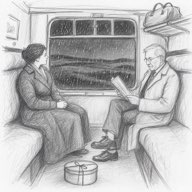
At twenty-three minutes past ten, Ruth Ellison discovered that the last carriage of the Whitby train contained only one other passenger. He wore a camel coat and polished shoes, though rain had soaked the coat's hem and darkened the shoes. Between his feet rested a dented biscuit tin tied with green string.
Ruth placed her overnight bag on the rack. The man looked up from a folded copy of the Yorkshire Post. "You are late," he said, as if they had arranged to meet.
"I nearly missed the train," Ruth replied. "That is different." She sat opposite him because the remaining seats were strewn with crisp packets. Beyond the glass, York's lights slid backwards into the wet October dark.
The stranger studied her face. "Margaret's daughter, aren't you? The solicitor from Leeds." His voice was educated but local. Ruth felt the familiar irritation produced by strangers who knew her family before they knew her.
"Who are you?"
"Daniel Vale. I taught history at Eskdale School until patience and funding expired together." He tapped the biscuit tin. "Your mother asked me to give you this if she lost her nerve. She did, repeatedly. Then she died. That rather settled the question."
Ruth's mother had been dead for eleven days. They had buried her that morning beside a yew tree in Sleights. At the wake, Aunt June had served ham sandwiches with curled edges and avoided every useful subject. Martin had spoken expansively about probate, although nobody had asked him. Nobody had mentioned Daniel Vale.
"You could have approached me at the funeral," Ruth said.
"Your uncle watched you like a customs officer." Daniel glanced towards the connecting door. "Besides, this concerns him. Open it after Grosmont, when the signal disappears. He cannot ring you then."
Ruth disliked instructions delivered as theatre. Nevertheless, when the train left the valley lamps behind and crossed a dark stretch of moorland, she untied the string. Inside lay school exercise books, a brass key and six photographs of a narrow stone cottage.
The first book contained her mother's neat handwriting. Each entry recorded rent received from a cottage called Bracken Fold. The payments continued for thirty-two years. Ruth recognised the tenant's name: Martin Ellison, her uncle, who had always claimed he owned the place.
"My grandfather left Bracken Fold to Mum," she said. "Martin told everyone she sold it to him."
Daniel nodded. "He persuaded her to sign a tenancy agreement while she was grieving. Later, he described it as a transfer. Margaret understood the deception eventually, but exposing him would have split the family. She preferred slow leverage."
The last exercise book contained only three recent entries. Martin had paid no rent. Instead, Margaret had written: Key retained. Original deed behind the pantry tiles. Ruth held up the brass key. "This opens the cottage?"
"No. It opens my desk at school." Daniel smiled at her disappointment. "The deed is there. Your mother moved it after Martin renovated the pantry. She knew he would eventually find the loose tile. She also knew he never entered a school unless summoned."
The train slowed outside Grosmont. A fox crossed the track, pale in the headlamps. Ruth closed the tin. "Why did she wait until now?"
"She did not." Daniel unfolded his newspaper and produced a solicitor's receipt. "Three weeks ago, she sent Martin the tenancy record and a formal contract at a fair purchase price. He signed four days before she died. He thinks you know nothing and expects you, as her executor, to approve completion once probate is granted."
Ruth began to laugh, softly at first. Her mother had not lost her nerve. She had arranged the transaction, the evidence and even the inconvenient witness. "You said she asked you to act if she lost her nerve."
"I lied to make you open the tin." Daniel returned to his newspaper. "Margaret said you inherited her caution, not her curiosity. She was wrong about one of them."
When the train reached Whitby, Uncle Martin was waiting beneath the iron canopy, holding Ruth's spare umbrella. He smiled with the confidence of a man who believed every document favoured him. She stepped onto the platform with the biscuit tin under one arm and kissed his cheek. "Thank you for coming," she said. "Tomorrow morning, we should discuss the rent."
VOCABULARY
last carriage: the final passenger coach in a train
camel coat: a smart overcoat made in, or resembling, camel-coloured wool
dented: marked by a hollow caused by an impact
strewn: scattered untidily over a surface or area
irritation: a feeling of annoyance or impatience
lost her nerve: became too frightened or uncertain to carry out an intended action
probate: the legal process of proving a will and administering a deceased person's estate
expansively: in a confident, lengthy or grand manner
customs officer: an official who checks people or goods crossing a border; here, a comparison suggesting intrusive scrutiny
moorland: open, uncultivated upland covered with rough grass or heather
tenancy agreement: a contract setting out the terms on which a person rents property
deception: the act of deliberately causing someone to believe something false
leverage: an advantage that can be used to influence a person or outcome
retained: kept in one's possession rather than surrendered
deed: a formal legal document proving ownership or recording a transaction
renovated: restored or improved a building or room
summoned: formally ordered or urgently requested to attend
solicitor's receipt: written confirmation from a solicitor that a document, payment or instruction has been received
executor: a person appointed to administer a deceased person's estate
probate is granted: the court has formally authorised the administration of an estate
approve completion: authorise the final legal stage of a property transaction
inconvenient witness: a person whose evidence disrupts another person's preferred version of events
caution: care taken to avoid risk, error or premature action
iron canopy: a roof-like metal structure covering part of a railway platform
MULTIPLE-CHOICE QUESTIONS
Choose the best answer based on the story.
1. At what time does Ruth discover how empty the last carriage is?
A. At 10:07 p.m.
B. At 10:23 p.m.
C. At 10:32 p.m.
D. At 11:23 p.m.
2. Why does Daniel's first remark sound presumptuous to Ruth?
A. He complains about the train company on her behalf.
B. He behaves as though their encounter was prearranged.
C. He assumes that she has taken his reserved seat.
D. He mistakes her for a railway employee.
3. What practical reason makes Ruth sit opposite Daniel?
A. The other seats are littered with crisp packets.
B. Her reserved place is beside the connecting door.
C. She wants a clearer view of York's lights.
D. The luggage rack is full above every other seat.
4. Which two facts does Daniel identify before Ruth learns his name?
A. Her profession and her connection to Margaret
B. Her destination and the contents of her bag
C. Her uncle's address and the date of the funeral
D. Her school and the cottage she has inherited
5. How does Ruth respond when the stranger demonstrates detailed knowledge of her?
A. She asks him directly to identify himself.
B. She changes seats without speaking.
C. She telephones her uncle for confirmation.
D. She pretends not to recognise Margaret's name.
6. What work did Daniel previously do?
A. He practised as a solicitor in Leeds.
B. He managed property near Grosmont.
C. He taught history at Eskdale School.
D. He worked as a conductor on the Whitby line.
7. What did Martin do at the wake without being invited to do so?
A. He discussed probate at length.
B. He introduced Daniel to the family.
C. He distributed copies of the tenancy record.
D. He offered to drive Ruth back to Leeds.
8. Where does Ruth say Daniel could have spoken to her earlier?
A. At the solicitor's office
B. At Bracken Fold
C. At the funeral
D. At Eskdale School
9. Why does Daniel want Ruth to wait until after Grosmont before opening the tin?
A. The train staff will lock the connecting door there.
B. Her uncle will be unable to telephone her once the signal is lost.
C. The cottage photographs become visible only beyond the valley lights.
D. Daniel plans to leave the train at that station.
10. Which set of objects does Ruth initially find inside the biscuit tin?
A. A deed, a newspaper and a solicitor's letter
B. Exercise books, a brass key and six photographs
C. Rent money, a school key and a purchase contract
D. A will, pantry tiles and a folded map
FILL IN THE BLANKS
Complete each sentence with the correct vocabulary word.
1. The rent payments had __________ for thirty-two years.
2. Martin told the family that Margaret had __________ the cottage to him.
3. Rather than expose Martin immediately, Margaret preferred slow __________.
4. Margaret's note stated that the key had been __________.
5. Margaret knew that Martin would not enter a school unless he was __________.
6. The fox appeared pale in the train's __________.
7. Martin expects Ruth to approve __________ after probate is granted.
8. Margaret's careful plan included Daniel as an inconvenient __________.
9. Daniel says Margaret thought Ruth had inherited caution but not her __________.
10. Martin waits for Ruth beneath the station's iron __________.
COMPREHENSION QUESTIONS
Answer each question using details from the story.
1. What contrast in Daniel's appearance suggests that he has recently been out in heavy rain?
__________________________________________
2. How does the folded newspaper contribute to Daniel's controlled first impression?
__________________________________________
3. What do the receding lights of York establish about the journey and its atmosphere?
__________________________________________
4. Why is Daniel's knowledge of Ruth especially irritating to her?
__________________________________________
5. Why does Daniel tap the biscuit tin while explaining his connection to Margaret?
__________________________________________
6. What does Daniel's phrase about patience and funding reveal about his personality?
__________________________________________
7. How does the description of Aunt June's behaviour characterise the family gathering?
__________________________________________
8. What suspicion is implicit when Ruth points out that Daniel could have approached her earlier?
__________________________________________
9. What does Daniel's customs-officer comparison imply about Martin's conduct at the funeral?
__________________________________________
10. Why is Ruth's decision to untie the string significant for her character?
__________________________________________
TRUE/FALSE QUESTIONS
Read each statement and decide whether it is true or false.
1. The rent records identify Martin as the tenant even though he has claimed to own Bracken Fold.
2. Ruth says that her grandfather left Bracken Fold to Margaret.
3. Martin obtained Margaret's signature during a period when she was grieving.
4. The three most recent entries show that Martin continued paying rent regularly.
5. The brass key opens Daniel's desk at Eskdale School rather than the cottage.
6. The fox crosses the track after the train has already arrived at Whitby.
7. Martin signed the purchase contract four days after Margaret died.
8. Ruth concludes that her mother ultimately lacked the courage to confront the property issue.
9. Daniel admits that he invented the claim about Margaret losing her nerve to prompt Ruth to open the tin.
10. Martin waits at Whitby without bringing anything useful for Ruth.