THE BLUE ENVELOPE
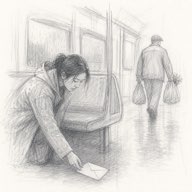
Rain followed Maya Chen into the Chicago train station after work. Her coat was wet, and one shoe made a soft squeak. She found a seat on the Brown Line beside a man with grocery bags. When he left, Maya noticed a blue envelope under his seat.
The envelope was thick and sealed with clear tape. On the front, someone had written, “River Street Community Center—Front Office.” Maya looked through the train window. Her stop was next. She picked up the envelope and asked, “Did anyone drop this?” No one answered.
At home, her roommate Carlos was making grilled cheese sandwiches. Maya placed the envelope on the kitchen table. “It might contain money,” she said. “I should take it to the police.” Carlos turned down the stove. “The center is only six blocks away. Call them first.”
A worried young man answered the phone. “We lost the fundraiser deposit,” he said quickly. “My name is Devon. I sold the tickets. I planned to put our white bank pouch inside a blue center envelope before I boarded the train.” Maya heard another voice say, “Check every pocket again.”
The rain had become colder, but Maya walked to the center. Paper snowflakes covered the front windows. Inside, children played basketball while two adults folded donated coats. Devon hurried toward her. He wore a green team jacket and looked about nineteen. “You found it,” he said with a deep breath.
Before Maya could hand it over, a woman named Ms. Holloway joined them. She was the center director. “We need to confirm what is inside,” she said. “Devon, how much did you collect?” Devon looked at the floor. “Eight hundred and forty dollars. I counted it twice.”
Ms. Holloway cut the tape. The envelope held no cash. It was full of small cards with children’s names and coat sizes. “Mr. Alvarez was bringing these from Edison School,” she said. Devon’s face lost its color. “That is not the deposit,” he whispered. Maya remembered the man with the grocery bags.
“The person beside me may have dropped this envelope,” Maya said. She described his red cap and the yellow roses in one bag. Ms. Holloway smiled with sudden hope. “That sounds like Mr. Alvarez. He teaches our cooking class, and he always buys flowers for his wife on Fridays.”
They called him, but his phone went straight to voice mail. Devon checked his backpack again. He opened the main pocket, then a side pocket, and finally a narrow space behind the lining. His hand stopped. He pulled out the center’s white bank pouch, much thinner than the envelope.
“Please tell me that is it,” Ms. Holloway said. Devon opened it. The cash and ticket list were inside. For a moment, nobody spoke. Then Maya laughed, and Ms. Holloway leaned against the desk. “You did not lose the deposit,” she said. “And Maya found our coat-size cards before they disappeared for good.”
Mr. Alvarez called ten minutes later. He had carried the coat cards from Edison School, then set them down while lifting his bags. “I did not notice the envelope was gone until I reached home,” he explained. He promised to bring cookies to the center the next morning.
Devon walked Maya to the door and offered her two fundraiser tickets. She accepted one and paid for the other. On Monday, the center called. Maya had won a bright red winter scarf. Carlos tried it on and said, “You know, honesty looks good on me.” Maya pulled the scarf away. “Honesty found the envelope,” she replied.
VOCABULARY
squeak: a short, high sound made by something rubbing
envelope: a flat paper cover used for a letter or document
sealed: closed firmly so that it cannot open easily
fundraiser: an event that collects money for a cause
deposit: money taken to a bank for safekeeping
roommate: a person who shares a home with someone
community center: a local place for public activities and services
confirm: to check and state that something is correct
collect: to receive or gather things from different people
coat size: the measurement used to choose a coat that fits
lining: the inside layer of cloth in a bag or piece of clothing
pouch: a small soft bag used to hold something
voice mail: a system that records a phone message
describe: to give details about how someone or something looks
donated: given to help a person or an organization
director: a person who manages an organization or program
ticket list: a record of people or tickets connected to an event
honesty: the quality of telling the truth and acting fairly
scarf: a piece of cloth worn around the neck
disappear: to become lost or impossible to see
MULTIPLE-CHOICE QUESTIONS
Choose the best answer based on the story.
1. Which Chicago train line was Maya riding?
A. The Brown Line
B. The Red Line
C. The Blue Line
D. The Green Line
2. What was Carlos making when Maya arrived home?
A. Tomato soup
B. Grilled cheese sandwiches
C. Chicken tacos
D. Pecan pie
3. What did Carlos advise Maya to do first?
A. Open the envelope
B. Return to the train
C. Call the community center
D. Take it to a bank
4. Who answered Maya's call at the center?
A. Mr. Alvarez
B. Devon
C. Ms. Holloway
D. Carlos
5. How much money did Devon say he had collected?
A. $480
B. $804
C. $840
D. $940
6. What was actually inside the blue envelope?
A. Cash and tickets
B. Coat-size cards
C. School photographs
D. Fundraiser receipts
7. Where had the cards in the envelope come from?
A. Harbor School
B. River Street Bank
C. Edison School
D. Maya's office
8. Which detail helped identify Mr. Alvarez?
A. A red cap and yellow roses
B. A blue coat and white shoes
C. A green jacket and a basketball
D. A black hat and a cake box
9. Where did Devon finally find the bank pouch?
A. Behind the desk
B. Inside a coat box
C. Under a train seat
D. Behind the lining of his backpack
10. What did Maya later win?
A. A red winter scarf
B. A grocery gift card
C. A cooking lesson
D. A new backpack
FILL IN THE BLANKS
Complete each sentence with the correct word.
1. A wet shoe may make a soft __________ on a smooth floor.
2. The clear tape kept the envelope firmly __________.
3. The center held a __________ to collect money for its programs.
4. Devon planned to take the cash __________ to the bank.
5. Carlos was Maya's __________ because they shared an apartment.
6. Please __________ the meeting time before you leave home.
7. A narrow space behind the bag's __________ hid the missing item.
8. The money was stored in a small white __________.
9. Mr. Alvarez's phone sent the first call to __________.
10. Volunteers folded coats that local people had __________.
COMPREHENSION QUESTIONS
Answer each question using details from the story.
1. Why did Maya pick up the envelope instead of leaving it on the train?
__________________________________________
2. Why was calling the community center a sensible first step?
__________________________________________
3. Why did Ms. Holloway open the envelope before accepting Devon's claim?
__________________________________________
4. How did Devon's own plan cause his confusion?
__________________________________________
5. How had Mr. Alvarez probably lost the envelope?
__________________________________________
6. Why did Maya's description of the passenger matter?
__________________________________________
7. What two problems were solved at the center?
__________________________________________
8. Why did Devon offer Maya fundraiser tickets?
__________________________________________
9. What does Maya's decision to pay for one ticket show?
__________________________________________
10. Why is Carlos's final comment humorous?
__________________________________________
TRUE/FALSE QUESTIONS
Read each statement and decide whether it is true or false.
1. Maya found the envelope while traveling home after work.
2. The man beside Maya had grocery bags.
3. The community center was six blocks from Maya's home.
4. Paper snowflakes decorated the center's windows.
5. Children were playing basketball inside the center.
6. Devon was wearing a blue team jacket.
7. Mr. Alvarez taught a cooking class at the center.
8. Mr. Alvarez often bought flowers for his wife on Fridays.
9. Mr. Alvarez promised to bring cookies the next morning.
10. Maya accepted both fundraiser tickets without paying.